
- Home
- »
- Next Generation Technologies
- »
-
Large Language Models Market Size & Share Report, 2033GVR Report cover

Large Language Models Market (2026 - 2033)
Size, Share & Trends Analysis Report By Application (Customer Service, Chatbots And Virtual Assistant, Content Generation), By Deployment (Cloud, On-premise), By Industry Vertical (Healthcare), By Region, And Segment Forecasts
Market Size, 2025
$7.4BMarket Estimate, 2026
$9.8BMarket Forecast, 2033
$95.6BCAGR, 2026–2033
38.5%Large Language Models Market Summary
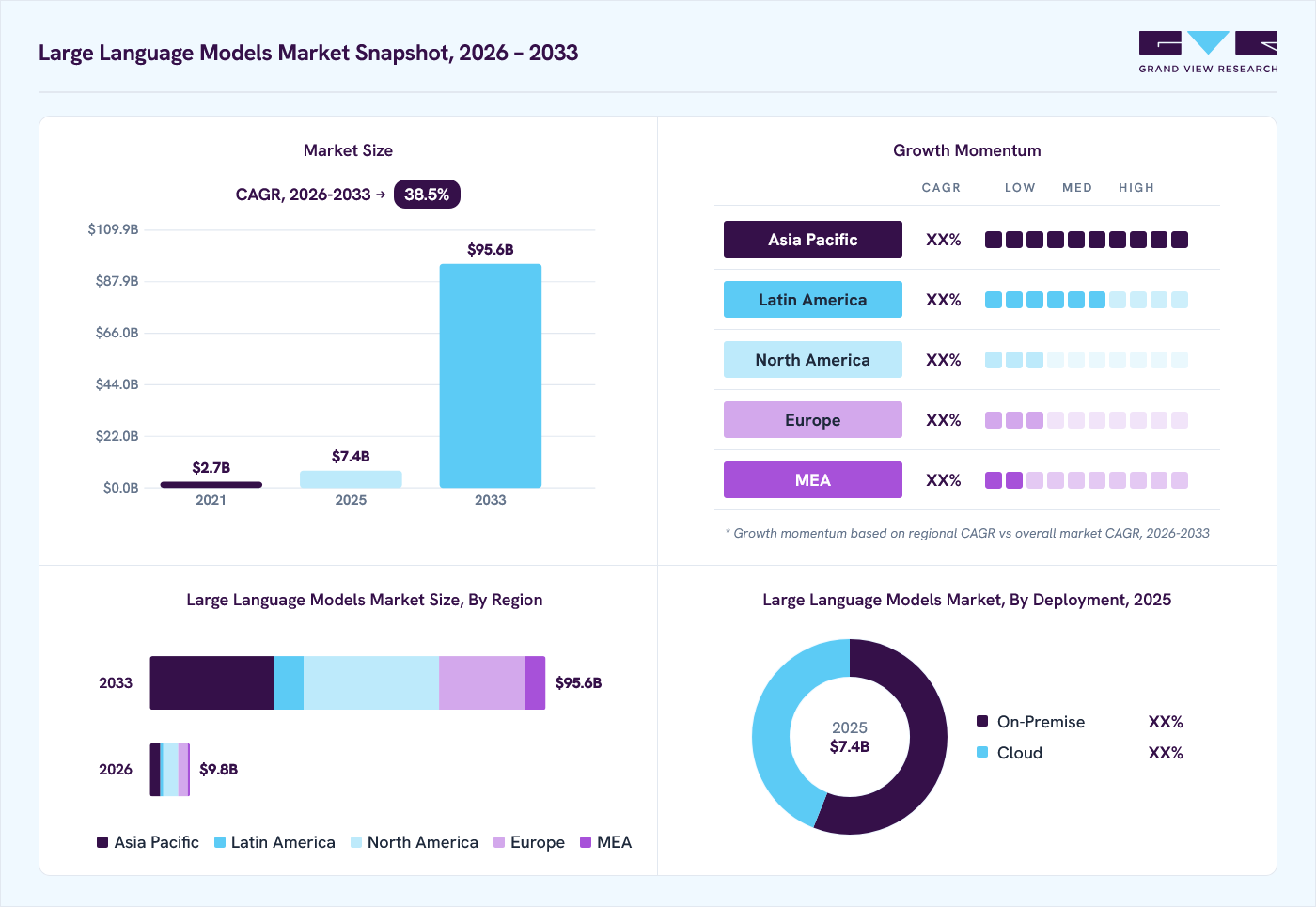
The global large language models market size was valued at USD 7.4 billion in 2025 and is projected to grow from USD 9.8 billion in 2026 to USD 95.6 billion by 2033, at a CAGR of 38.5% from 2026 to 2033. North America dominated the market, accounting for a revenue share of 37.1% in 2025. The market is driven by rapid generative AI adoption, increasing natural language processing (NLP) integration, expanding enterprise AI deployments, rising demand for AI copilots and intelligent virtual assistants, growing investment in foundation models, advancements in multimodal AI, increasing cloud AI infrastructure adoption, and accelerating AI model fine-tuning across industries.
 Source: Grand View Research, IR Documents, Primary Interviews, Paid DatabasesTo learn more about this report,
 Download Free Sample Report
 Key Market Trends & Insights
- By application: Chatbots and virtual assistant segment dominated the market, with a revenue share of over 27% in 2025.
- By deployment: On-premises segment held the largest revenue share in 2025.
- By industry vertical: Retail and e-commerce segment held the largest revenue share in 2025.
Regional Highlights
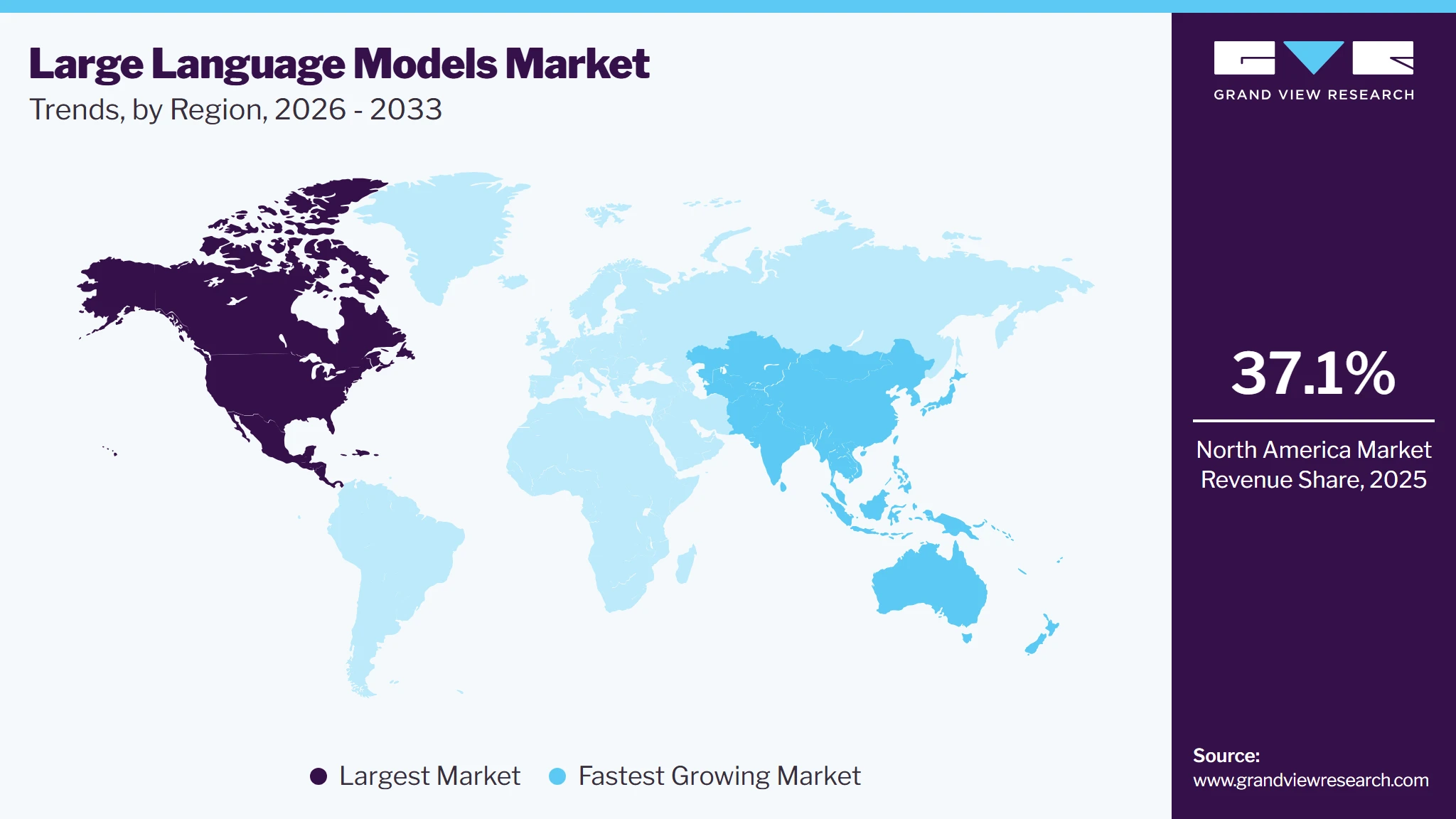
- Largest regional market: North America (37.1% revenue share, 2025)
- Fastest growing regional market: Asia Pacific (highest CAGR, 2026-2033)
- By country: The U.S. held the largest market share in 2025.
Market Size & Forecast
- Market size in 2025: USD 7.4 Billion
- Estimated market size in 2026: USD 9.8 Billion
- Projected market size by 2033: USD 95.6 Billion
- CAGR (2026-2033): 38.5%
Three ways to get this report
Buy it, customize it, or ask a question.Ask an Analyst
A direct answer, usually in 1 working day
- AccessReport author, directly
- Reply timeWithin 1 working day
- No sales callDirect answer only
- FormatEmail reply
- CostFree, no cost
Get the Full Report
What the study covers
- FormatsPDF · Excel · Dashboard
- Timeline2026–2033 annual, 2025 base
- Coverage20+ countries, 5 regions
- Companies10+ key players profiled
Customize the Report
20% free customization
- IncludeCountries, segments, points
- TailorTo your product definition
- ExtendDeeper competitor detail
- OrA fully bespoke study
- Turnaround5–10 working days
This capability increases efficiency by enabling models to autonomously learn and adapt without continual manual oversight, significantly reducing time and resource demands. It promotes scalability, enabling LLMs to accommodate expanding data volumes and workloads effortlessly. For instance, in June 2023, Databricks, Inc., a software company headquartered in the U.S., completed a USD 1.3 billion acquisition of MosaicMLL, a U.S.-based provider specializing in large language models and model-training software. This strategic move aims to enhance Databricks' generative AI capabilities. Databricks plans to integrate MosaicMLL's models, training, and inference capabilities into its lakehouse platform, empowering enterprises to create generative AI applications.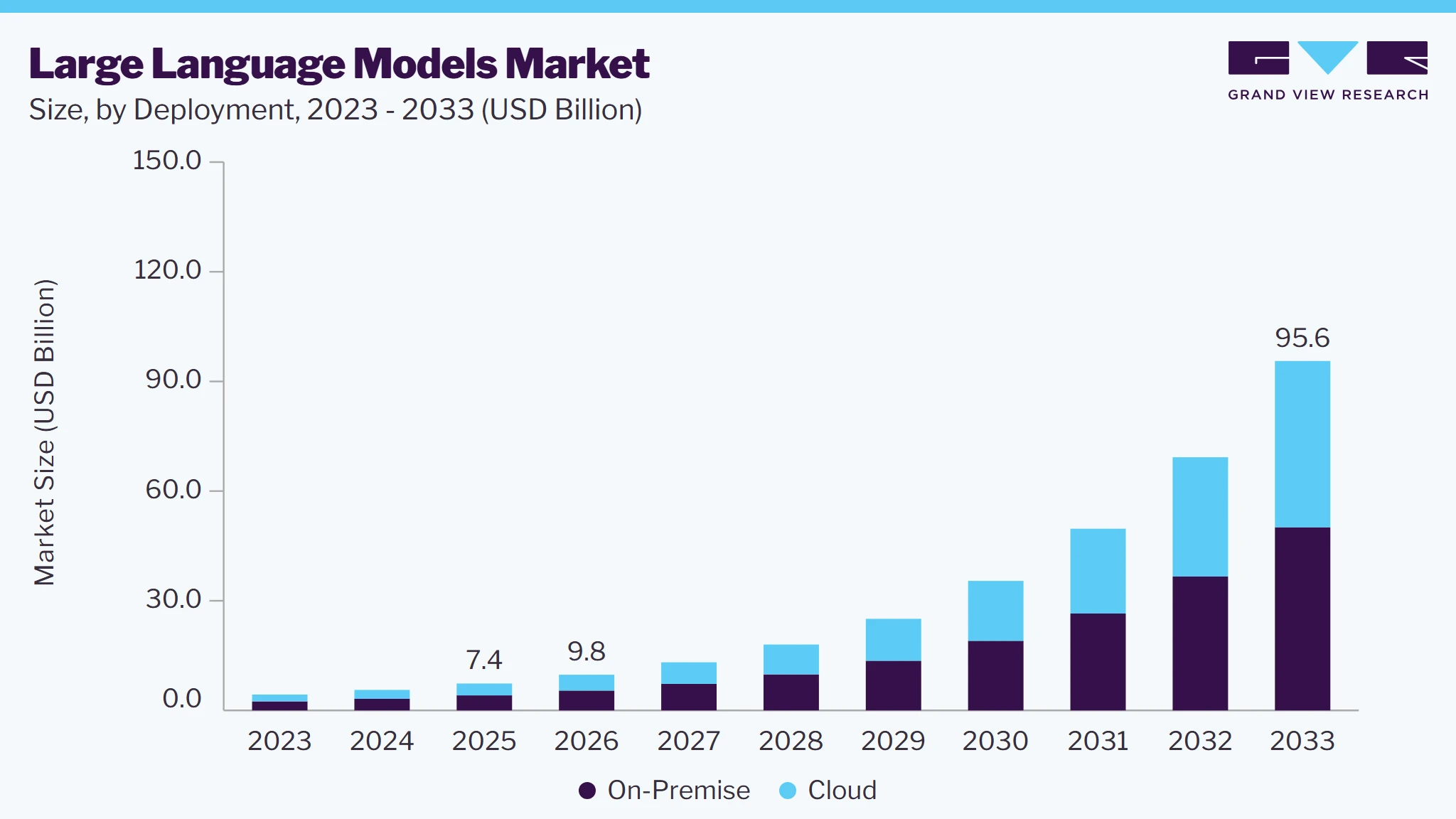 To learn more about this report, Download Free Sample Report
 The emerging trend in the LLM market is the development of models customized for specific industries or scientific domains, such as Earth science and astrophysics. These specialized models are designed to process complex, domain-specific data more effectively. Consequently, organizations can achieve higher accuracy in tasks such as data analysis, research, and decision-making within their respective fields. For instance, in June 2024, NASA, an independent agency of the US federal government, and IBM Corporation collaborated to develop INDUS, a suite of large language models (LLMs) customized for five key scientific domains, including Earth science and astrophysics. The models, designed for improved performance in scientific tasks such as question-answering and data retrieval, feature a custom vocabulary and domain-specific training, enhancing their ability to process complex scientific data and assist researchers in accessing valuable insights.
Techniques such as transfer learning and self-supervised learning have significantly advanced Large Language Models (LLMs), allowing them to utilize pre-trained knowledge and adapt to new tasks more effectively. Moreover, breakthroughs in hardware, particularly GPUs (Graphics Processing Units) and TPUs (Tensor Processing Units) have accelerated both training and inference processes, enabling the handling of larger, more complex models. These advancements have enhanced LLMs' performance by improving contextual understanding, memory handling, and training efficiency. Consequently, companies such as OpenAI, Google LLC, and Microsoft are increasingly adopting these models to boost operational efficiency, gain a competitive advantage, and ensure long-term financial sustainability in their respective industries.
The vast availability of internet data has significantly driven the growth of the large language models (LLM) industry. This extensive data serves as a key resource, allowing LLMs to learn from a wide variety of sources, resulting in improved performance and adaptability. With access to such rich information, LLMs can develop a better understanding of context, enhance language comprehension, and improve their capabilities in diverse language-related tasks. The abundance of data fuels continuous advancements in LLM technology, expanding their applications across various industries and accelerating their adoption in the market.
Market Dynamics
The large language models market is experiencing robust growth, driven by increasing adoption of generative AI platforms, AI-powered automation, and large-scale transformer models across enterprise applications. Rising demand for domain-specific LLMs, retrieval-augmented generation (RAG), AI agents, and context-aware language models is enabling organizations to enhance decision-making, customer engagement, and knowledge management. Continuous investments in GPU computing infrastructure, AI model optimization, synthetic data generation, and parameter-efficient fine-tuning are improving model performance while reducing deployment costs. Growing emphasis on responsible AI, LLM governance, model security, AI compliance, and data privacy is encouraging enterprises to implement secure and transparent AI frameworks. Furthermore, expanding adoption of multilingual AI models, open-source LLMs, edge AI inference, and AI orchestration platforms is creating new commercialization opportunities and accelerating innovation across the large language models market.
The large language models market is witnessing strong momentum as enterprises increasingly deploy generative AI, AI copilots, and enterprise LLMs to automate workflows, improve productivity, and enhance customer experiences. Organizations across banking, healthcare, retail, manufacturing, and information technology are integrating natural language processing (NLP) and foundation models into business-critical applications. Growing demand for intelligent document processing, AI-powered customer support, content generation, and knowledge management is expanding commercial adoption of LLM-based solutions. Continuous improvements in transformer architectures, context-aware AI, and multimodal models are enabling more accurate and scalable enterprise deployments. These advancements are strengthening the long-term growth trajectory of the large language models market.
Businesses are also investing in private LLMs, domain-specific language models, and retrieval-augmented generation (RAG) to improve data security and response accuracy. Increasing availability of cloud AI platforms, GPU infrastructure, and AI model fine-tuning services is reducing implementation barriers for organizations of all sizes. Strategic collaborations between AI developers, cloud providers, and enterprise software vendors are accelerating commercial deployment across industries. The growing focus on AI automation, digital transformation, and workflow intelligence continues to expand the addressable market for advanced language models. As enterprises prioritize operational efficiency and innovation, demand for Large Language Models is expected to increase substantially.
The large language models market continues to face challenges due to the substantial computational resources required for LLM training, AI inference, and large-scale model deployment. Developing and maintaining advanced foundation models requires significant investments in high-performance GPUs, cloud computing infrastructure, and energy-intensive data centers. These high infrastructure costs create adoption barriers, particularly for small and medium-sized enterprises with limited technology budgets. In addition, the increasing complexity of AI model governance and LLM lifecycle management adds operational challenges for enterprises. These factors can slow the pace of widespread commercial implementation.
Concerns related to data privacy, AI security, regulatory compliance, and confidential information protection also remain significant restraints for market expansion. Organizations are becoming more cautious about sharing proprietary data with public generative AI platforms due to cybersecurity and intellectual property risks. Compliance with evolving AI regulations requires additional investments in responsible AI, model transparency, and governance frameworks. Managing AI hallucinations, model bias, and output reliability further increases implementation complexity for enterprises. Consequently, many organizations are adopting LLM solutions gradually while strengthening internal AI governance practices.
The large language models market presents significant opportunities through the growing adoption of industry-specific LLMs, vertical AI solutions, and multimodal AI across enterprise environments. Organizations are increasingly developing customized language models for healthcare, financial services, legal services, manufacturing, education, and customer support applications. These specialized AI models deliver higher accuracy by leveraging industry-specific knowledge and enterprise data. Rising demand for AI assistants, digital employees, and enterprise automation is creating new commercial opportunities for solution providers. This trend is supporting the development of differentiated AI products with higher business value.
The increasing popularity of edge AI, on-device LLMs, and hybrid AI deployment models is expanding market opportunities beyond cloud-only environments. Advancements in AI model compression, parameter-efficient fine-tuning, and small language models (SLMs) are making enterprise AI deployments more cost-effective and scalable. Growing investments in AI infrastructure, sovereign AI initiatives, and enterprise AI ecosystems are further supporting market expansion across developed and emerging economies. Businesses are also adopting AI orchestration platforms to integrate multiple language models into enterprise workflows. These developments are expected to unlock substantial long-term revenue opportunities across the large language models market.
Market Concentration & Characteristics
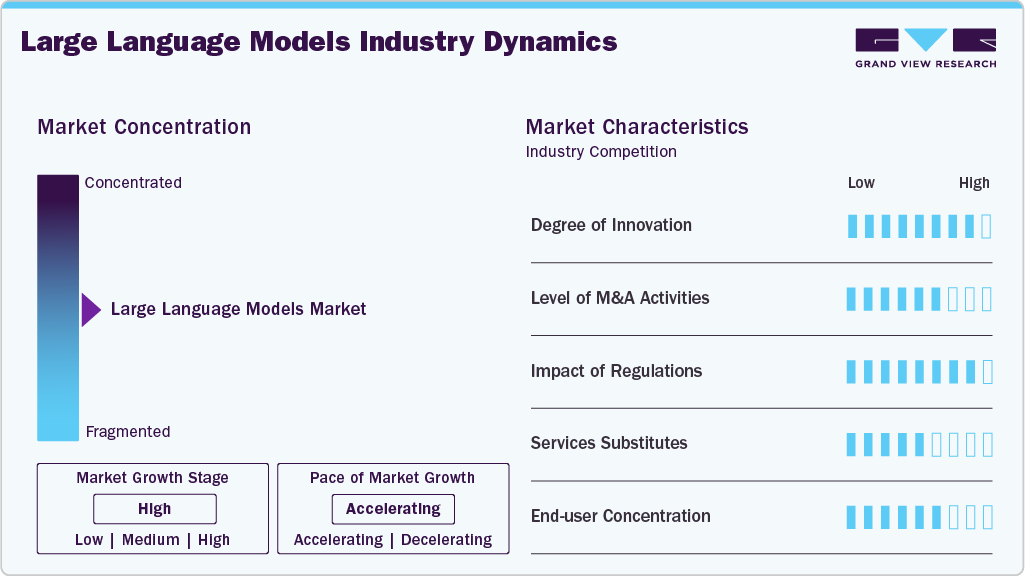
The large language models market is moderately concentrated, with a limited number of global technology companies holding significant market share through their investments in foundation models, generative AI, and AI infrastructure. Leading market participants compete by expanding LLM capabilities, improving multimodal AI, and developing high-performance enterprise AI platforms for commercial applications. The market is characterized by continuous innovation in natural language processing (NLP), AI model optimization, and retrieval-augmented generation (RAG) to enhance model accuracy and scalability. Strategic partnerships among cloud service providers, semiconductor companies, and AI developers are strengthening competitive positioning and accelerating product commercialization.
 To learn more about this report, Download Free Sample Report
 The competitive landscape is evolving rapidly with the emergence of open-source LLMs, domain-specific language models, and small language models (SLMs) that address industry-specific requirements. Companies are increasingly differentiating their offerings through AI model fine-tuning, LLM governance, AI security, and responsible AI capabilities to meet enterprise compliance standards. Rising investments in GPU infrastructure, AI inference optimization, and edge AI deployment are further intensifying market competition across developed and emerging economies. As enterprise adoption expands, the large language models market is expected to witness increasing product diversification, technological advancements, and strategic investments throughout the forecast period.
Analyst Perspective
The large language models market is expected to witness sustained momentum owing to the increasing adoption of agentic AI, AI inference, and semantic search across enterprise environments. The market is experiencing a growing trend toward reasoning models, prompt engineering, and context engineering to improve the accuracy and reliability of AI-driven applications. Rising investments in vector search engines, LLM observability, and model distillation are supporting more efficient, scalable, and cost-effective AI deployments. Enterprises are increasingly integrating synthetic data pipelines, federated learning, and low-latency inference to strengthen AI performance while meeting governance and compliance requirements. Consequently, continuous advancements in enterprise AI architectures and intelligent automation are expected to create significant growth opportunities for the large language models market throughout the forecast period.
Application Insights
Based on application, the chatbots and virtual assistant segment led the market with the largest revenue share of over 27% in 2025. The ability to easily integrate AI into apps enables the creation of more personalized chatbots and virtual assistants. These AI-powered solutions help businesses automate customer support, sales, and other services, driving efficiency. Consequently, companies can offer seamless and interactive experiences, improving customer engagement and satisfaction. For instance, in July 2023, Google Cloud launched Conversational AI on Gen App Builder, a platform that enables developers, even without ML experience, to create AI-powered chatbots and virtual assistants for tasks such as customer support, automation, and personalized services. The tool streamlines generative AI integration, enabling faster implementation of natural interactions and ensuring security and reliability.
The customer service segment is expected to experience at a significant CAGR over the forecast period, driven by advancements in LLM technology. LLMs offer scalable solutions, allowing businesses to handle multiple customer queries simultaneously without the need for proportional resource expansion. This scalability ensures that businesses can efficiently accommodate fluctuating demands without compromising on service quality. Moreover, LLMs provide consistent and accurate responses, helping maintain brand identity and uniformity in customer interactions. By automating routine tasks, LLMs enable human agents to focus on more complex customer needs, ultimately enhancing the overall quality of service delivery.
Deployment Insights
Based on deployment, the on-premises segment led the market with the largest revenue share of over 56% in 2025, driven by businesses' need for greater control over their data and security. With sensitive customer information at stake, many companies prefer on-premise solutions to ensure strict data governance and compliance with regulatory requirements. These solutions also offer more flexibility for customization, enabling organizations to customize the system to their specific needs. Moreover, on-premise deployments provide faster processing speeds, as data does not need to be transmitted over the internet. The on-premise segment is poised to maintain strong growth as organizations continue prioritizing security and performance.
The cloud segment is experiencing rapid growth. Cloud-based LLM solutions offer scalability, enabling businesses to easily adjust resources according to demand. This flexibility, combined with a pay-as-you-go pricing model, makes it cost-effective for companies to optimize expenses. The cloud segment is further driven by its ability to support global collaboration and remote access, allowing businesses to utilize the power of AI across borders. As more companies adopt cloud infrastructure, it is expected to continue dominating the market, offering enhanced performance and security features.
Industry Vertical Insights
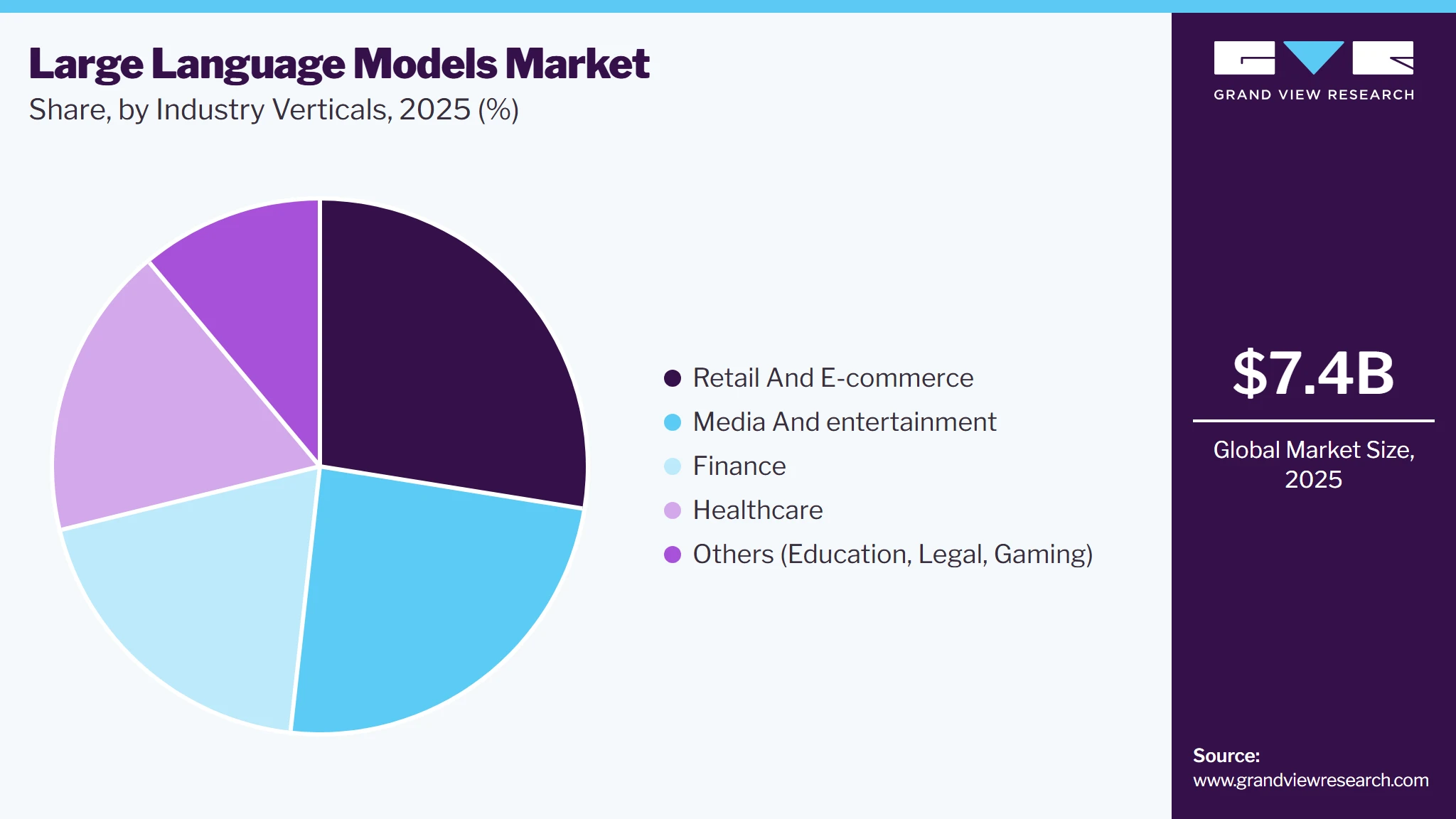
Based on industry vertical, the retail and e-commerce segment led the market with the largest revenue share of over 27% in 2025. In the LLM market, the retail and e-commerce sectors are using AI to deliver personalized recommendations and improve product search experiences. LLMs enhance customer support through chatbots and virtual assistants that manage inquiries, process orders, and provide real-time help, reducing costs. AI-driven content generation also aids in creating product descriptions, reviews, and marketing materials more efficiently. As consumer demand for seamless shopping and automation increases, LLMs are becoming integral in optimizing retail and e-commerce processes.
 To learn more about this report, Download Free Sample Report
 In the media and entertainment sector, LLMs are transforming content creation by generating scripts, articles, and social media posts, speeding up production processes. They enhance customer engagement by providing personalized content recommendations, improving user experience on platforms such as streaming services. LLMs also assist in automating content moderation, ensuring compliance with community guidelines, and filtering harmful content. As demand for diverse and high-quality content grows, LLMs are becoming an essential tool for innovation and efficiency in media and entertainment.
Regional Insights
North America dominated the large language models market with the largest revenue share of 37.1% in 2025, driven by its advanced technology infrastructure and the presence of major AI-focused companies. The region’s continuous investments in AI innovation and research fuel widespread adoption across industries, including finance, healthcare, and retail. Governments and private organizations are also heavily backing AI research and development, further accelerating the growth of LLMs.
 To learn more about this report, Download Free Sample Report
 U.S. Large Language Models Market Trends
The large language models market in the U.S. held the largest share in the North America region in 2025. The U.S. is a central hub for large language model innovation, with tech giants such as Google LLC, Microsoft, and OpenAI pushing the boundaries of AI research. Its vast and varied industries, from finance to healthcare, are increasingly adopting LLMs to improve efficiency, automate processes, and enhance customer experiences. The government’s regulatory framework and investments in AI infrastructure ensure a conducive environment for LLM growth.
Europe Large Language Models Market Trends
The large language models market in Europe is emerging as a strong player, with countries such as the UK, Germany, and France focusing on integrating AI into various sectors. The European Union's focus on data privacy and AI ethics also shapes the market’s development and adoption. European businesses are utilizing LLMs to streamline operations and improve customer experiences across industries such as manufacturing, retail, and healthcare. The region’s growing emphasis on digital transformation is expected to drive further LLM advancements in the coming years.
Asia Pacific Large Language Models Market Trends
The large language models market in Asia Pacific is rapidly advancing in the LLM industry, with countries such as China, Japan, and India investing heavily in AI technologies. China, in particular, is focusing on becoming a global AI leader, with significant resources directed towards AI research and LLM integration. Japan is utilizing LLMs to improve automation in industries such as robotics and manufacturing. Meanwhile, India’s expanding tech sector and increasing adoption of LLMs for customer service and education are also contributing to the region’s strong growth trajectory.
Key Large Language Models Company Insights
Some of the key companies in the large language models industry include Alibaba Group Holding Limited, Amazon.com, Inc., Baidu, Inc. and others. Organizations are focusing on increasing customer base to gain a competitive edge in the industry. Therefore, key players are taking several strategic initiatives, such as mergers and acquisitions, and partnerships with other major companies.
-
Alibaba Group Holding Limited is heavily investing in LLMs to enhance its e-commerce, cloud computing, and AI capabilities. The company has developed its own AI models, such as AliMe, which improve customer service and shopping experiences on its platforms. Alibaba's LLMs are also being integrated into its cloud services to offer scalable AI solutions to businesses. The company's focus is on creating more intelligent, efficient tools for both consumer-facing and enterprise applications.
-
Amazon.com, Inc. has integrated LLMs into its retail, cloud services, and virtual assistant technologies, such as Alexa. Its AWS cloud division offers tools for businesses to build and deploy LLM-based applications, enabling innovation across various sectors. Amazon's focus is on using LLMs to improve product recommendations, customer service, and logistics. The company is continually evolving its AI capabilities to create smarter, more personalized shopping experiences for consumers.
Key Large Language Models Companies
The following key companies have been profiled for this study on the large language models market.
-
Alibaba Group Holding Limited
-
Amazon.com, Inc.
-
Baidu, Inc.
-
Google LLC
-
Huawei Technologies Co., Ltd.
-
Meta Platforms, Inc.
-
Microsoft
-
OpenAI LP
-
Tencent Holdings Limited
-
Yandex NV
Competitive Benchmarking
Operating Strategies
Competitive Edge
Weaknesses
Mature Players: Microsoft, Google LLC, Amazon.com Inc., Meta Platforms Inc., Alibaba Group Holding Limited
- Mature players focus on expanding foundation models, generative AI platforms, enterprise AI services, multimodal AI capabilities, and cloud-based Large Language Models offerings.
- Their competitive advantage lies in extensive cloud infrastructure, strong AI research capabilities, broad enterprise customer bases, and significant investments in AI computing infrastructure and foundation models.
- These companies may face challenges related to high infrastructure costs, increasing regulatory scrutiny, AI governance requirements, and the complexity of scaling advanced language models.
Emerging Players: OpenAI LP, Baidu Inc., Huawei Technologies Co., Ltd., Tencent Holdings Limited, Yandex NV
- Emerging players focus on developing specialized Large Language Models, industry-specific AI applications, AI agents, multilingual models, and model optimization technologies.
- Their strength comes from rapid innovation, specialized AI expertise, regional market leadership, and agile development of enterprise-focused generative AI solutions.
- Limited global market penetration, dependence on strategic partnerships, and comparatively lower cloud infrastructure scale may constrain broader market expansion.
Recent Developments
-
In April 2024, Microsoft collaborated with G42, an artificial intelligence company in UAE, focusing on accelerating AI innovation, expanding digital access, and supporting AI workforce development in the UAE and surrounding regions. As part of this collaboration, G42’s Arabic LLM, Jais, will be available in the Azure AI Model Catalog, providing generative AI access to over 400 million Arabic speakers.
-
In December 2023, Google LLC launched VideoPoet, a versatile multimodal LLM that generates videos from text, images, and audio, showcasing unprecedented video generation capabilities. This model employs a decoder-only architecture and a two-step training process, enabling it to produce content for tasks beyond its specific training.
-
In September 2022, Meta Platforms, Inc., a U.S.-based technology company, collaborated with Microsoft to introduce Llama 2, a Large Language Models, marking an extension of their artificial intelligence partnership. The objective behind Llama 2 is to present a high-performing Large Language Models (LLM) that excels across diverse domains, serving both research and commercial needs while establishing competition with established LLMs.
Large Language Models Market Report Scope
Report Attribute
Details
Market size value in 2025
USD 7.4 billion
Estimated market size in 2026
USD 9.8 billion
Projected market size by 2033
USD 95.6 billion
Growth rate
CAGR of 38.5% from 2026 to 2033
Base year for estimation
2025
Historical data
2021 - 2024
Forecast period
2026 - 2033
Quantitative units
Revenue in USD million/billion and CAGR from 2026 to 2033
Report coverage
Revenue forecast, company ranking, competitive landscape, growth factors, and trends
Segments covered
Application, deployment, industry vertical, region
Regional scope
North America; Europe; Asia Pacific; Latin America; MEA
Country scope
U.S.; Canada; Mexico; Germany; UK; France; China; Japan; India; South Korea; Australia; Brazil; Saudi Arabia; South Africa; UAE
Key companies profiled
Alibaba Group Holding Limited; Amazon. com Inc; Baidu Inc; Google LLC; Huawei Technologies Co Ltd; Meta Platforms Inc; Microsoft; OpenAI LP; Tencent Holdings Limited; Yandex NV
Customization scope
Free report customization (equivalent up to 8 analysts' working days) with purchase. Addition or alteration to country, regional & segment scope.
Pricing and purchase options
Avail customized purchase options to meet your exact research needs. Explore purchase options
Global Large Language Models Market Report Segmentation
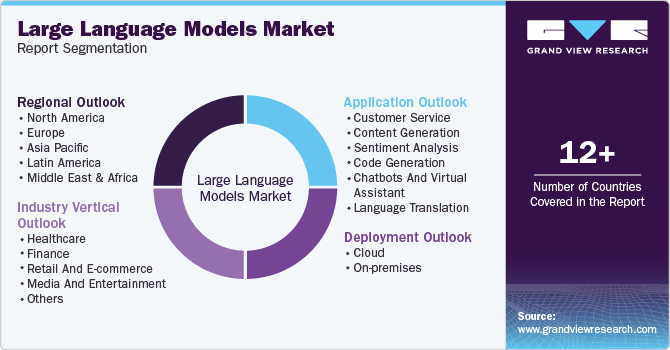
This report forecasts revenue growth at global, regional, and country levels and provides an analysis of the latest industry trends and opportunities in each of the sub-segments from 2021 to 2033. For this study, Grand View Research has segmented the global large language models market report based on the application, deployment, industry vertical and region:
 To learn more about this report, Download Free Sample Report
 -
Application Outlook (Revenue, USD Million, 2021 - 2033)
-
Customer Service
-
Content Generation
-
Sentiment Analysis
-
Code Generation
-
Chatbots And Virtual Assistant
-
Language Translation
-
-
Deployment Outlook (Revenue, USD Million, 2021 - 2033)
-
Cloud
-
On-premises
-
-
Industry Vertical Outlook (Revenue, USD Million, 2021 - 2033)
-
Healthcare
-
Finance
-
Retail And E-commerce
-
Media And Entertainment
-
Others
-
-
Regional Outlook (Revenue, USD Million, 2021 - 2033)
-
North America
-
U.S.
-
Canada
-
Mexico
-
-
Europe
-
UK
-
Germany
-
France
-
-
Asia Pacific
-
China
-
Japan
-
India
-
Australia
-
South Korea
-
-
Latin America
-
Brazil
-
-
Middle East & Africa (MEA)
-
KSA
-
UAE
-
South Africa
-
-
Research Methodology
The large language models market figures in this report are based on a proven research process that combines executive interviews with secondary research from proprietary databases, company filings, and recognized regulatory and institutional sources. Market size is built through value-chain sizing-reconciling supply-side and demand-side estimates-and triangulated with bottom-up and top-down approaches. Every estimate passes multiple levels of expert validation before publication, with each large language models segment quantified using the revenue-capture definitions in the table below.
Segment Definition
Segment - Application
Revenue capture definition
Customer Service
The customer service segment comprises large language model solutions used to automate customer interactions, resolve inquiries, and provide personalized support across digital communication channels. These applications improve response accuracy, reduce service costs, and enhance customer experience through intelligent conversational capabilities.
Content Generation
This segment includes large language models designed to create written, visual, or structured content such as articles, marketing copy, product descriptions, reports, and creative materials. It enables organizations to accelerate content production while maintaining consistency and quality across multiple use cases.
Sentiment Analysis
The sentiment analysis segment encompasses large language model applications that evaluate text to identify emotions, opinions, and customer attitudes. These solutions help businesses gain actionable insights from reviews, social media, surveys, and other textual data sources.
Code Generation
Code generation segment refers to the use of large language models for generating, completing, debugging, and optimizing software code across various programming languages. These solutions enhance developer productivity by automating repetitive coding tasks and supporting software development workflows.
Chatbots And Virtual Assistant
The chatbots and virtual assistant segment covers AI-powered conversational systems that interact with users through natural language to provide information, complete tasks, and deliver personalized assistance. These solutions are deployed across customer service, enterprise operations, education, and digital commerce environments.
Language Translation
This Language Translation segment consists of large language model applications that convert text between multiple languages while preserving context, tone, and meaning. It supports multilingual communication for businesses, governments, and consumers across global markets.
Segment - Deployment
Revenue capture definition
Cloud
The Cloud segment includes large language model solutions deployed through cloud infrastructure and delivered as scalable, on-demand services. It enables organizations to access advanced AI capabilities without maintaining dedicated computing infrastructure.
On-premises
This On-premises segment consists of large language model deployments installed and managed within an organization's own IT infrastructure. It is preferred by enterprises requiring greater control over data security, regulatory compliance, and system customization.
Segment - Industry Vertical
Revenue capture definition
Healthcare
The Healthcare segment represents the use of large language models in clinical documentation, medical research, patient engagement, diagnostics support, and healthcare administration. These applications improve operational efficiency while assisting healthcare professionals with data-driven decision-making.
Finance
The Finance segment covers large language model applications for fraud detection, financial analysis, regulatory compliance, customer support, and investment research. These solutions help financial institutions automate complex workflows and improve operational accuracy.
Retail And E-commerce
The Retail and E-commerce segment comprises large language model solutions that support personalized shopping experiences, product recommendations, customer engagement, inventory insights, and content creation. These applications improve operational efficiency while enhancing digital commerce interactions.
Media And Entertainment
The Media and Entertainment segment cover large language model applications for content creation, scriptwriting, audience engagement, localization, and digital media production. These tools streamline creative workflows and enable organizations to deliver personalized content experiences.
Others
The Others segment includes large language model applications across industries such as education, legal services, manufacturing, government, telecommunications, and logistics. These deployments address specialized operational, analytical, and communication requirements beyond the primary industry verticals.
Estimation Model
Layer Name
Key Questions
Description
Enterprise AI Demand Layer
Who creates demand for Large Language Models?
Identify enterprises, government agencies, educational institutions, healthcare providers, financial organizations, software companies, and digital-native businesses adopting Large Language Models to automate workflows, enhance decision-making, and improve customer engagement. This layer establishes the demand base by assessing AI adoption maturity, digital transformation initiatives, data availability, and investments in enterprise AI applications.
AI Infrastructure & Compute Deployment Layer
Who invests in Large Language Models infrastructure?
Evaluate investments in GPU clusters, AI accelerators, cloud computing platforms, high-performance computing (HPC), data centers, networking infrastructure, vector databases, and AI storage systems required to develop, train, fine-tune, and deploy Large Language Models. This layer measures infrastructure spending that enables scalable and efficient AI model development and inference.
Large Language Models Platform & Deployment Adoption Layer
Who deploys Large Language Models platforms and services?
Assess enterprise adoption of foundation models, generative AI platforms, AI copilots, retrieval-augmented generation (RAG), AI agents, API-based LLM services, model fine-tuning platforms, and AI orchestration solutions across industry verticals. This layer captures commercial adoption of LLM software, cloud services, deployment platforms, and implementation services supporting enterprise AI transformation.
Large Language Models Market Revenue Realization Layer
How much revenue is generated through Large Language Models adoption?
Estimate total market revenue by combining spending on LLM software, API usage, cloud subscriptions, AI model licensing, enterprise deployment, model customization, consulting, system integration, training, maintenance, and managed AI services. This layer captures revenue generated across healthcare, finance, retail and e-commerce, media and entertainment, manufacturing, education, government, and other enterprise sectors.
Delivered Customizations
This report has been delivered with the following In-depth customizations
Client Request
Customization Delivered
Value Adds
Large Language Models Technology Adoption & Growth Assessment
Performed a comprehensive assessment of Large Language Models market trends, including generative AI, foundation models, AI agents, retrieval-augmented generation (RAG), multimodal AI, AI copilots, and model fine-tuning technologies across major industry verticals.
Enables stakeholders to identify high-growth AI technology segments, evaluate enterprise adoption trends, prioritize investments, and strengthen competitive positioning.
Industry-Specific Large Language Models Deployment Analysis
Assessed adoption of Large Language Models across healthcare, finance, retail and e-commerce, media and entertainment, education, manufacturing, and other industries, covering content generation, customer service, code generation, language translation, and intelligent automation applications.
Provides insights into industry adoption patterns, application demand, digital transformation initiatives, and long-term revenue opportunities.
Cloud, AI Infrastructure & Enterprise LLM Opportunity Assessment
Evaluated adoption trends for cloud AI platforms, GPU infrastructure, AI inference, enterprise LLMs, AI orchestration, vector databases, and edge AI deployment across global markets.
Supports investment and product strategies by identifying emerging AI opportunities, accelerating innovation, enabling solution differentiation, and expanding market presence.
Frequently Asked Questions About This Report
The global large language model market size was valued at USD 7.4 billion in 2025 and is estimated at USD 9.8 billion in 2026.
Key factors that are driving the market growth include ongoing advancements in AI, particularly in deep learning architectures and natural language processing (NLP) algorithms, and increasing requirements in various industries for AI applications centered around language.
The chatbots and virtual assistant segment led the market with the largest revenue share of over 27% in 2025.
The on-premises segment led the market with the largest revenue share of over 56% in 2025.
The retail and e-commerce segment led the market with the largest revenue share of over 27% in 2025.
Asia Pacific is the fastest-growing region over the forecast period.
The global large language model market is expected to grow at a CAGR of 36.9% from 2026 to 2033 to reach USD 95.6 billion by 2033.
North America dominated the market, accounting for a revenue share of 37.1% in 2025.
Key players include Alibaba Group Holding Limited; Amazon. com Inc; Baidu Inc; Google LLC; Huawei Technologies Co Ltd; Meta Platforms Inc; Microsoft; OpenAI LP; Tencent Holdings Limited; Yandex NV
About the Author(s)
Next Generation Technologies Research Team
Technology · Next Generation TechnologiesThis report was authored by the next generation technologies research team at Grand View Research - comprising two research analysts, one senior research analyst, and one industry expert - with specialized expertise in the next generation technologies segment of the technology industry. All findings are based on proprietary technology databases, executive interviews, and regulatory analysis, subject to internal peer review prior to publication.
Last Updated:
Speak to Analyst

Customize this report to your needs - add regions, segments, or data points, with 20% free customization.
Or view our licence options:


ISO 9001:2015 & 27001:2022 Certified
We are GDPR and CCPA compliant! Your transaction & personal information is safe and secure. For more details, please read our privacy policy.


